Loan Status Prediction
 PythonStreamlit
Loan Status Prediction is a machine-learning project that predicts whether a loan will be fully paid or charged off, giving financial institutions a fast, data-driven signal for credit-risk assessment — trained on a real Kaggle dataset and deployed as a real-time Streamlit app anyone can try.
Architecture and Tech Stack
Core Architecture
- Language: Python (pandas, numpy)
- Machine learning: scikit-learn + XGBoost (XGBRFClassifier),
joblibfor model persistence - Data: Kaggle credit dataset (
Credit_train.csv), cleaned intotrain_data_processed.csv - App & deployment: Streamlit + Streamlit Cloud for a real-time prediction UI
- Environment: Google Colab / Jupyter notebook for exploration and training,
.devcontainerfor reproducibility
ML Pipeline
A single, reproducible flow from raw Kaggle data to a live prediction: exploration and cleaning, feature encoding and scaling, training and comparing several classifiers, selecting the best by metrics, and persisting it for the Streamlit app to serve.
Key Features
Dataset
- Source: Kaggle —
Credit_train.csv - Key features: Credit Score, Annual Income, Monthly Debt, Years of Credit History, number of open accounts, current credit balance, maximum open credit, loan purpose, and home-ownership status
- Target: whether the loan is fully paid or charged off
Models & Results
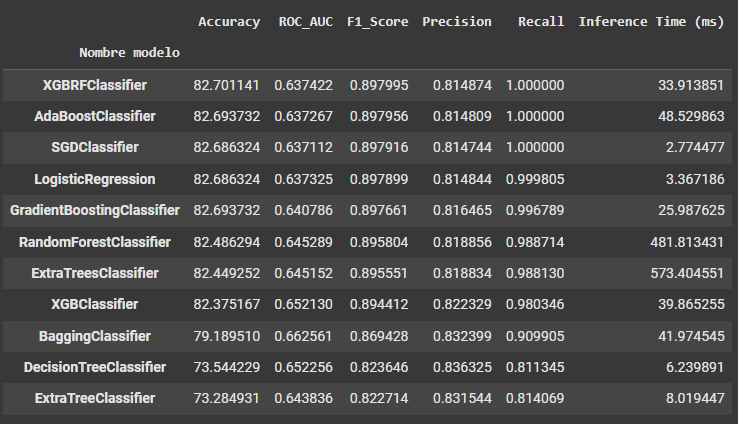
Six classifiers were trained on the same processed data and compared on accuracy, F1, AUC-ROC and inference time. XGBRFClassifier won on the balance of predictive quality and speed.
| Model | Role |
|---|---|
| XGBRFClassifier | Best — combines gradient boosting + random forest |
| Random Forest | Compared |
| Logistic Regression | Compared |
| Gradient Boosting | Compared |
| AdaBoost | Compared |
| SGDClassifier | Compared |
Best model — XGBRFClassifier:
- Accuracy: 82.7%
- F1 Score: 0.89
- AUC-ROC: 0.64
- Inference time: 32.3 ms
Most influential features: Credit Score, Annual Income, and Years of Credit History.
Technical Highlights
Model choice driven by metrics, not a single number
The winner wasn't picked on accuracy alone — six models were compared across accuracy, F1, AUC-ROC and inference time, and XGBRFClassifier was selected for giving the best balance rather than topping any one metric in isolation.
Inference speed treated as a first-class metric
At 32.3 ms per prediction, the model is fast enough for interactive, real-time credit decisions — a property that matters as much as accuracy when the result feeds a live approval flow.
Reproducible preprocessing and model persistence
Missing-value handling, de-duplication, label encoding, StandardScaler and the train/validation split are captured once and saved as a processed dataset plus a persisted model (joblib), so the Streamlit app loads exactly the model that was evaluated.
Project Structure
loan-status-prediction/
├── loan-status-prediction.ipynb   # EDA, preprocessing, training, model comparison
├── app.py                         # Streamlit real-time prediction UI
├── XGBRFClassifier.pkl            # Persisted best model (joblib)
├── train_data_processed.csv       # Cleaned / encoded training data
├── requirements.txt               # Python dependencies
└── .devcontainer/                 # Reproducible dev environment
Impact and Scalability
- Real-time credit-risk signal: instant fully-paid vs. charged-off prediction from an applicant's features
- Interpretable drivers: surfaces the features that most influence the decision (Credit Score, Income, credit history), not just a black-box score
- Speed-aware: 32 ms inference supports interactive decision-making at approval time
- Reproducible & deployable: a persisted model + processed data + Streamlit Cloud means anyone can run the exact demo
Notes
Built in Python with scikit-learn and XGBoost, deployed on Streamlit Cloud. Code is public on GitHub. Try the live app at loan-status-prediction-unal.streamlit.app.
🖼️ IMAGE PLACEHOLDER — Streamlit app UI: the loan-application form and the prediction result